

'Rebirth': Boycott Over Earrings2026-04-13
Chinese drama release schedule for 2026 


For the English version, we use automatic translation with minor editing. We apologize to our dear readers for any errors. | |
|
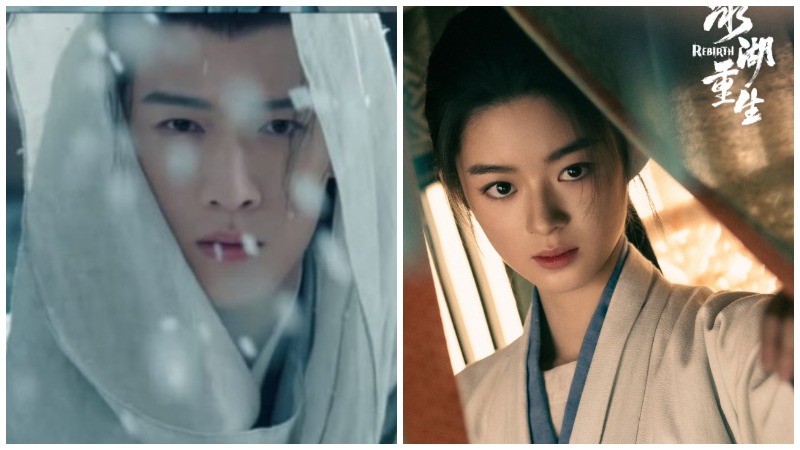
Released on April 8 on iQiyi and Tencent Video, the drama "Rebirth" (冰湖重生, 楚乔:冰湖重生, Frozen Awakening, Ice Lake Rebirth) looks set to go down in history as a catastrophic failure. What’s more, the case may well end up in textbooks on crisis PR and reputation management in the media industry. The project was positioned as the second part of the cult classic "Princess Agents". To begin with, it showed fairly solid pre-booking numbers: over 1.34 million on both platforms, and 5 million on premiere day - quite respectable. Shortly after release, the ratings — as they say in Russia - went into negative growth. On Douban, China’s leading review aggregator, the score started at 5.1 out of 10, then dropped to 3. Users actively gave it 1 and 2 ratings, with comments calling it a "pathetic sequel." Maoyan: 8th place among currently airing dramas. Taiwan’s Netflix: the drama fell from an initial 3rd place to 6th. Tencent Video saw the original 2017 drama "Princess Agents" - made in a much less flashy style, without stunning special effects - suddenly soar back into the top 3, which is quite humiliating for a sequel that has just started airing. WeTV: overall ranking 17th place. On television, CCTV-1’s ratings crossed the 3% mark, which is still quite good. For a free state channel, a CVB rating of 1.5% is already considered very strong. With a 3% rating, "Rebirth" became the second most successful premiere of 2026 on CCTV-1. The first was "Hold a Court Now". This gap in ratings further highlights the contrast between state TV and online streaming (the internet, in short). But low ratings are only part of the problem — the visible tip of the iceberg. The key indicator of failure is the total absence of advertising. A top-tier S-class drama launched with zero ad integrations (a so-called "naked broadcast"), an extremely rare and telling phenomenon for a project of this level. Tencent and iQiyi have so far (episode 15 is already airing) failed to attract any advertisers, even though the drama’s banner occupies prime spots on the platforms’ homepages. Even lower-ranked projects usually have several ad integrations from the start. A "naked broadcast" is a sure sign that investors have no faith in the project. The original series "Princess Agents" worked with over 40 brands — a record at the time. This raises the question: how did advertisers make a negative forecast at the decision-making stage, before the drama had even aired? They hadn’t seen its artistic flaws (or merits). The answer, apparently, lies in the reputational risks assessed by advertisers, chief among them the scandal surrounding the earrings of the young lead actress, Huang Yang Dian Tian. Read more: Huang Yang Dian Tian’s earrings draw attention to the income of her father, a former official Of course, now that the series is out, there is no shortage of criticism about its artistic value: the heroine is too young and unconvincing, lacks charisma, comes across as a "child general"; the directing is a failure; there is an aestheticization of violence; the strong dramatic tension of the first season has given way to a soapy love opera wrapped in a revenge plot. Viewers note with bitterness that in chasing profits, the producers lost the very soul of the project: "Before, Chu Qiao used to say, ‘I want to change this world.’ Now her main goal is to win a man’s heart." But let’s be honest - what series hasn’t faced similar criticism? There are plenty of truly bad series, and even good ones that get panned. Yet none of them end up with a "naked broadcast"; they somehow manage to get by, recoup their budgets, and find their audience. Here, a tsunami simply broke loose. And the cause of public anger is seen in Huang Yang Dian Tian’s earrings. In the spring of 2025, she wore a piece of jewelry worth 2.3 million yuan to a school ceremony. At the time, she was still a schoolgirl - even if she occasionally earned money from films, hardly such large sums (or so one would think). But the actress had a father - a civil servant and, conveniently, an entrepreneur named Yang Wei. On April 20, 2013, a magnitude 7.0 earthquake struck Sichuan, not far from the city of Ya’an. 196 people died, over 11,000 were injured, and more than 1.5 million people were affected. Rumors circulated that Yang Wei had been involved in distributing funds to victims of that earthquake. The issue of embezzlement of money intended for disaster relief came up - a deeply painful topic for Chinese society. Provincial authorities in Sichuan launched an investigation. The inquiry established that Yang Wei had no connection whatsoever to the distribution of earthquake relief funds. During that period, he worked in the Ya’an Urban Management Bureau, in a department dealing with street maintenance and combating unlicensed street vending (no explanation is needed of what urban maintenance and street vending entail). The investigation also determined that the earrings were a fake made of glass and alloys, worth about 100 yuan. Violations were found on Yang Wei’s part: he combined civil service with running a business, which is prohibited, and he had a second child, which was also forbidden at the time. But no major corruption schemes were officially uncovered. At the time, it seemed that everything had blown over. The authorities issued a ruling that cleared Yang Wei. And as we can see, his daughter’s drama was not canceled. Yet something went wrong. It turns out that even after the refutation, the reputational damage remained. Huang Yang Dian Tian is now invariably referred to as "the earring girl," and a certain segment of the audience is firmly determined to boycott projects featuring her - and is doing so very successfully. After the scandal, the actress had only two unreleased projects on her list: "Rebirth" and "Mermaid". The fate of the second project remains unclear; it was planned for Tencent Video but was pulled, and its release future is in doubt, especially after the public - and, more importantly, advertisers - reacted to "Rebirth". Interestingly, despite the exonerating official verdict on Yang Wei, not a single brand dared to associate its name with his daughter’s series - so toxic had the topic become. Another gap, as noted above, is between content delivery platforms. While the series is doing well on state TV, on streaming platforms (Tencent Video, iQiyi) it is a complete failure. The discrepancy in numbers between television and online clearly indicates that the active, paying, "advanced" audience is ignoring the project. So a fairly large segment of the population, for some reason, did not trust their own authorities. In the public eye, the actress’s family is firmly associated with corruption, nepotism, and a society where the elite can get away with anything. Society expressed distrust in a system that, in its view, conducted a "check-the-box" investigation and left questions unanswered. Society spoke out against the children of elites who receive undeserved privileges and opportunities. Society signaled that it remembers the money meant for earthquake victims and will not let the issue be simply brushed aside. In the years following the disaster, numerous officials at various levels were exposed and punished for embezzlement and local abuses - from direct misappropriation of payments, to bribes for reconstruction contracts, to misuse of funds, to charity theft. For brands that live on reputation, such associations are a disaster. They collectively refused to place ads, fearing a boycott and the wrath of an audience sensitive to such issues. As one analysis aptly put it, "advertisers decided it was better to invest nothing than to face a backlash." But to fear such a backlash, you first need to have a way to measure it - a method trusted by both brands and the audience. This suggests that China’s tools for measuring success or failure are indeed effective and diversified, with one metric cross-checked against another. And through these tools, the audience has a channel to voice its opinion. And once again, we see that this is the internet audience, not state TV. Still, political activism alone does not fully explain the disaster surrounding "Rebirth". After all, brands could have ignored the scandal - the authorities had backed the official version. And Huang Yang Dian Tian is not the only actor in the series; other perfectly marketable celebrities are also involved. What makes this case unique is that the failure happened on two levels simultaneously, which rarely intersect so dramatically: an ideological boycott by the audience that scared off advertisers before the premiere, followed by confirmation of the series’ low quality, which left no chance for a turnaround. As one publication wrote, audiences never reject established franchises, but they absolutely cannot stand a poorly made "nostalgia exploitation". The failure of the "Princess Agents" sequel, nine years later, proves that status is determined not only by flashy visuals but also by the actors’ commitment, a quality script, and shared values. The feeling of "nostalgia exploitation" is very familiar to Russian viewers, who have been literally bombarded with remakes of Soviet classics. And it seems that anger over "nostalgia exploitation" was the last straw. The political scandal triggered a snowball effect, where the protest and the series’ low quality constantly fed and amplified each other. The result was a "perfect storm" that appears to have destroyed the project. We’ll see how it all ends. According to Russian law, we are obligated to warn users that Instagram and Facebook are owned by META Platforms Inc., which is considered extremist under Russian law and its activities are prohibited in Russia. |
|
| Категория: News | | |